What Your Favorite Brain Teaser Says About Your Personality
FakeIQ Staff
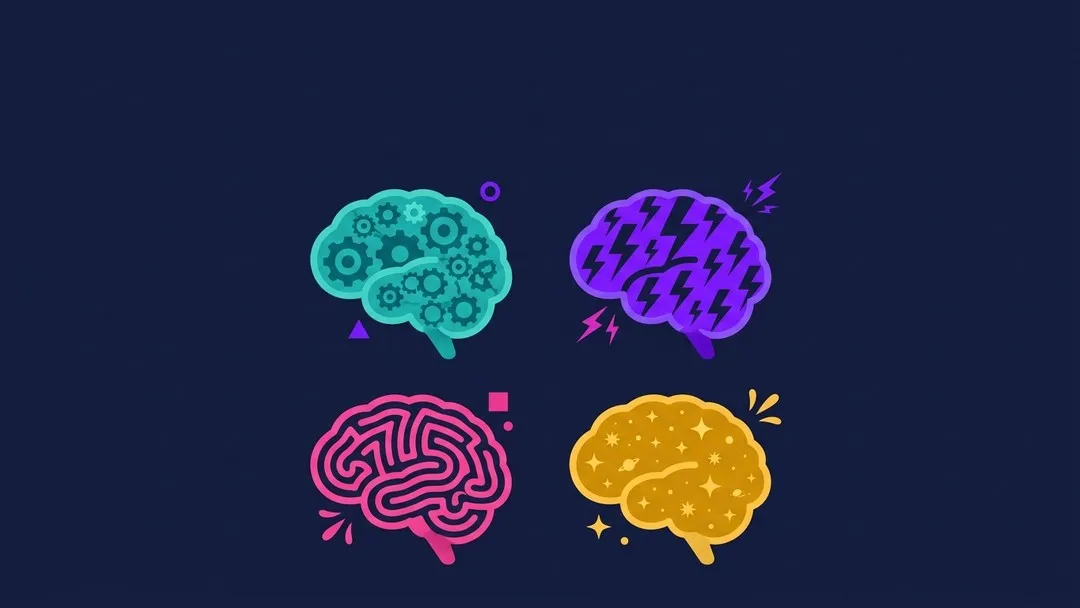
Everyone has a type. Not just in dating — in puzzles too.
Some people gravitate toward logic grids. Others live for riddles. There’s a subset of the population that genuinely enjoys Sudoku, and honestly, those people frighten me a little. But here’s the thing: the kind of brain teaser you reach for first says something real about how your mind processes the world.
This isn’t some horoscope nonsense. (Well, okay, it’s a little bit horoscope nonsense.) But there’s actual cognitive science behind why certain puzzle types feel satisfying to certain brains. Let’s get into it.
The Lateral Thinker: You Love Riddles
Your go-to: “A man walks into a restaurant and orders albatross soup. He takes one sip and kills himself. Why?”
If riddles are your thing, you’re the kind of person who solves problems by coming at them sideways. You don’t try to out-logic a problem — you try to reframe it entirely. In a meeting, you’re the one asking, “But what if we’re solving the wrong problem?” People either love you or want to throw a stapler at you.
Lateral thinkers tend to excel in creative fields, entrepreneurship, and any job that involves the phrase “think outside the box” (even though lateral thinkers would reject that cliche on principle). You’re also probably the friend who figures out the twist in a movie thirty minutes before everyone else and can’t resist mentioning it.
Cognitive style: Divergent thinking. Your brain generates multiple possible solutions and then converges on the weirdest one. Research from the creativity and cognition lab at Northwestern shows that people who solve insight problems (riddles, essentially) show a burst of activity in the right anterior superior temporal gyrus — the brain’s “aha!” region. Your aha-region is probably jacked.
The Pattern Matcher: You Love Sequences
Your go-to: “What comes next: 1, 1, 2, 3, 5, 8, …”
If you can spot the Fibonacci sequence from across a crowded room, your brain runs on pattern recognition. You’re the person who notices when a restaurant changes its menu layout or when a coworker’s email signature is one pixel off. This isn’t obsessive — okay, it’s a little obsessive — it’s your brain’s default mode.
Pattern matchers tend to end up in data science, music, mathematics, or any field where seeing structure in chaos is a superpower. You probably also have strong opinions about which route to take home, because you’ve mentally optimized every possible combination of traffic lights.
Cognitive style: Sequential and analytical. Your brain looks for rules, tests them, and extends them. Studies on fluid intelligence — the ability to solve novel problems without prior knowledge — show that sequence-based reasoning is one of its purest measures. If you enjoy these puzzles, your fluid intelligence is probably doing heavy lifting in your daily life, even when you don’t notice.
The Brute-Force Logician: You Love Logic Grids
Your go-to: “Five people live in five houses of five different colors. The Brit lives in the red house. The Swede keeps dogs…”
Logic grid enthusiasts are a special breed. You enjoy elimination. You like crossing things off. There’s a deep satisfaction in methodically narrowing possibilities until only one configuration remains. You probably also enjoy spreadsheets and would organize your bookshelf by color if your partner let you.
People who love logic grids tend to be detail-oriented, patient, and slightly terrifying in an argument. They won’t let you get away with sloppy reasoning. They’ll pin you down with “But earlier you said…” until you surrender. These are the people who read the terms of service.
Cognitive style: Systematic and deductive. Your brain works like a proof: given these premises, what must be true? The psychologist Daniel Kahneman calls this “System 2” thinking — slow, deliberate, and effortful. While most people default to fast, intuitive judgments, you actually enjoy engaging the analytical machinery. That takes genuine cognitive discipline, and if you think that sounds like a humble-brag, you’re absolutely right.
The Visual Thinker: You Love Spatial Puzzles
Your go-to: Tangrams, jigsaw puzzles, or anything involving rotating 3D shapes in your mind.
Spatial puzzle lovers think in pictures. When someone gives you directions, you’re building a mental map in real time. When you read a novel, you’re constructing a physical space for the characters to inhabit. You also probably dominated the “which of these shapes is the same shape rotated?” section of every standardized test you’ve ever taken.
This cognitive style is overrepresented among architects, surgeons, engineers, and people who are inexplicably good at parallel parking. Your brain has a gifted visuospatial sketchpad — the mental workspace where you hold and manipulate visual information.
Cognitive style: Spatial reasoning. This is one of the components of IQ that standardized tests actually measure reasonably well. Mental rotation tasks light up the parietal cortex, and people who score well on them tend to have strong working memory for visual information. If someone says “picture this” and you literally do, that’s you.
The Wordsmith: You Love Word Puzzles
Your go-to: Crosswords, anagrams, or “What’s a word that means X and also Y?”
You’re a word nerd and you know it. Language is your playground. You probably read dictionaries for fun as a kid (or at least the interesting parts of dictionaries, which is all of them, because you’re that person). You have opinions about the Oxford comma, and they are strong.
Word puzzle enthusiasts tend to have high verbal intelligence and excellent crystallized knowledge — the accumulation of facts, vocabulary, and learned procedures. You’re the person who wins at Scrabble and then explains why “qi” is a legitimate word while everyone stares at you with undisguised resentment.
Cognitive style: Verbal-linguistic. Your brain is wired for language manipulation, and crossword-solving studies show it activates both the language centers and the memory retrieval networks simultaneously. You’re basically running a full-text search on your entire vocabulary every time someone says “five-letter word for obstinate.” It’s “balky,” by the way.
The Chaos Agent: You Love Trick Questions
Your go-to: “How many months have 28 days?” (All of them.)
You don’t actually want to solve puzzles. You want to watch other people fail at them. You live for the moment someone confidently says “February!” and you get to deliver the devastating correction. You’re the human equivalent of a trapdoor.
Trick question lovers tend to be contrarians with a sharp sense of humor. You question assumptions as a hobby. If someone tells you the sky is blue, you’ll point out that it’s actually violet and our eyes just can’t process it properly. You’d probably enjoy our Fake Genius Test — or you’ve already sent it to three friends just to watch them fail.
Cognitive style: Metacognitive. You think about thinking. You’re aware of cognitive biases not because you studied them formally but because you find them hilarious. You’re also deeply annoying at pub quizzes, and you wouldn’t have it any other way.
So What Does This Actually Mean?
Look, no personality framework based on puzzle preferences is going to capture the full complexity of a human being. That’s the whole problem with IQ tests — they try to reduce intelligence to a single number, and brains just don’t work that way.
But here’s what is real: people do have cognitive styles. You do tend to approach problems in characteristic ways. And understanding your preferred mode of thinking can be genuinely useful — not because it tells you what you’re good at, but because it tells you what feels natural, which isn’t the same thing.
The brain teasers that frustrate you most? Those are probably exercising cognitive muscles you don’t use as often. And like actual muscles, they get stronger with practice. So maybe try a brain teaser that isn’t your type sometime. It’ll be uncomfortable. That’s the point.
Now if you’ll excuse me, I need to go solve a logic grid. Not because it reveals something about my personality. I just really enjoy crossing things off.